Kamis, 16 Juni 2011

Toads and Butterflies


I found this American Toad hopping near the pond in the south part of the nature center a couple of days ago.  He did not look happy.  He was completely covered with cottonwood "cotton" seed "fluff."  I took most of it off before I took the pictures.  
              
You can see how dejected he looked here.  The cottony seeds clung like sticky paper.  I'm sure with every bug he ate a ball of this stuff ended up in his mouth. 

I have friends that have this same expression when cottonwood seeds are blowing around.


In the picture below a Prairie Ringlet butterfly has landed near a Prairie Smoke flower that has gone to seed.  These medium sized butterflies are only out for about two weeks in early summer then they dissappear until next year. I didn't notice the aphids near its feet until after I took the picture

Minggu, 12 Juni 2011

Sunrise Dew on Spider Webs, Flowers , and Damselflies

 Sunrise comes very early this time of year at Springbrook--before 5:30 AM, but the rewards were worth it this morning, with heavy dew on everything.  The spiderwebs look like jewels as the sun comes up and shows them off.  I was trying out a new macro camera lens this morning, so lots of close up pictures.
The horizon line is inverted in each dew drop as it functions as a lens until the warmth of the sun evaporates it away.
The mosquitos were pretty intense after the sun came up with no wind, so it was with a great deal of pleasure that I found several in the spider webs.  This little web had three of them stuck fast.  Go spiders!
The Large Flowered Penstamon are blooming now in the south prairie.  There are more than I have ever seen, and each large flower head was completely covered with large dew drops.  I took a lot of pictures. This plant is smooth and waxy, so large droplets form, unlike the Prairie Smoke below.
Prairie Smoke is almost finished blooming at Springbrook, but the seed head stage is the most noticable and is the reason for the name of the plant.  Looking across the prairie the bunches of seed heads look like smoke, especially on a misty morning. This morning the dewy seed heads were visible all across the prairie.  Tiny hairs on each seed plume only allow very tiny droplets of dew to form, making the seed head look frosty.
 Here I have enlarged the center of the picture above so the tiny droplets can be seen.  They make the seed plumes look like delicate glassware.

It was only after I took this picture this morning and then enlarged it that I was able to see this fine detail with the dew.  I won't see Prairie Smoke the same again, though it has always been one of my favorites.
The damselflies were covered with dew this morning, and hard to find on the grass stems.  This is one of the few pictures I was able to get of one from the side.

They are too wet and heavy to fly until the sun removes the dew, but they rotate around the grass stem trying to hide. It works pretty good, except their eyes really stick out, as you can see below.
The little black dots in the globe like eyes follow you whereever you move.  I'm sure it has something to do with the way light is reflected in the eyes, but it feels like two tiny pupils keeping watch on your every move.  These little predators eat mosquitos too, yes!!

Minggu, 05 Juni 2011

Red Winged Black Birds and Mother Leaches

While many pairs of Red Winged Blackbirds have young ready to leave the nest, this pair was just beginning to build their nest this past wednesday in Springbrook's south prairie. 

The male perched in the top of the nearest tree and scolded any one who came close, while the female selected the best pieces of  nest material for her interior decorating. 
 The male and female look very different.  The males want to attract attention to themselves so all will know the boundaries of his territory.  Thus, his bright colors.

The female has to sit on the nest and not be seen by predators, so she has colors that blend with the surroundings.

I will try to get pictures of the nest as the eggs and then babies hatch and grow.
This large female leach was caught by one of the students doing pond study at Springbrook this past week.  Female leaches have babies at this time of year, and they carry the babies with them for several weeks until they are big enough to be on their own.

The babies stay on the mother leach's underside. So I poured some pond water into a casserole dish and took these pictures from underneath looking up through the glass bottom.

Don't tell the cook. 
These leaches are large, about 3 or 4 inches long.

Sabtu, 04 Juni 2011

Red Bellied Woodpeckers and Spittle Bugs

 I don't know that Red Bellied Woodpeckers and spittle bugs have anything in common except that spittle bugs are present when Red Bellies have young in their nests. 

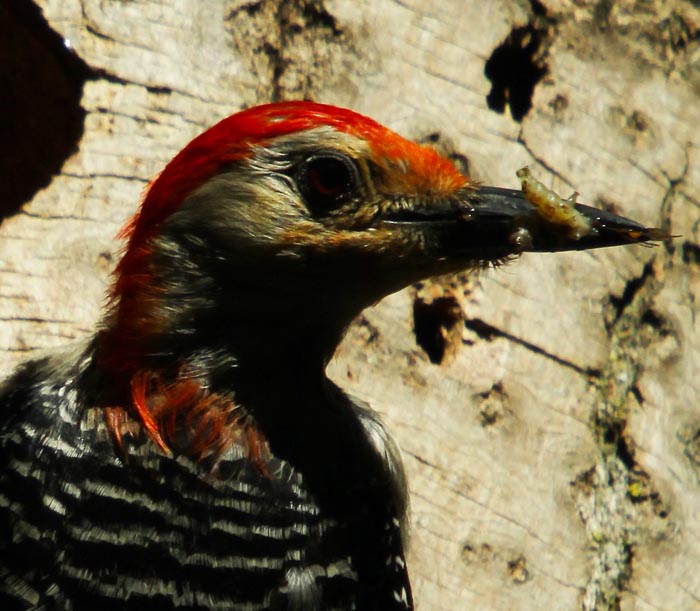
This is a male Red Bellied Woodpecker bringing food to it's nest in Springbrook Nature Center's woodlands this past Wednesday. 

As can be seen in the second photo below, the bugs he is finding in the trees look real yummy!


These look like some kind of fly larvae but could also be beetle or wasp larvae.  In any case they are full of protein and fat, and will help the baby woodpeckers grow. 

This male was returning to the nest about every 20 minutes, and I didn't see the female, so I wondered if she is still inside the nest with very little babies, and he is feeding her?
This female came to the suet feeder a few days ago and was taking away big strings and gobs of suet, so she must have a different nest and is feeding her babies suet.  One more reason to keep your suet feeders full all summer.  Mine goes down faster in the summer than in the winter.

You can tell that this is a female because the red on her head only goes half way to her beak.  On the male the red goes all the way across the head to the beak, as you can see in the picture above and below.
This is a photo I took in February of a male Red Bellied Woodpecker where you can actually see the red in its belly.

You don't see this very often, and many people wonder why they are called Red Bellied...now you can see the reason.  
Spittle Bugs hide in the blobs of white spit like material that can be seen on little plants in fields and prairies right now.  I took these pictures on Wednesday morning in Springbrook's south prairie.  Spittle bugs are actually immature leaf hoppers.  They protect themselves by producing lots of moist bubbles around themselves.  While hiding inside they suck the juices from the plant they are on, which gives them enough extra liquid to produce even more bubbles.  These little bugs live their entire childhoods and adolescence in a bubble bath!
You can see the little immature bug in this picture which I took after pushing away the bubbles.  The back end of a second bug can be seen in the top left of the picture, and there was a third in the top center, but it cannot be seen, as it was under the bubbles.

Leaf Hoppers, spittle bugs at this age, are in the group of insects known as Hemiptera, or, "true bugs."  All "true bugs" have sucking mouth parts, as these little guys demonstrate very well.

In the two pictures below you can see how the little 1/4 inch "bug" started creating more bubbles as soon as he was exposed.  He was completely encased in new bubbles in seconds.

These bugs must have predators, although I have never seen anything hunting in the "spit" for anything to eat.  Would you?

Jumat, 20 Mei 2011

Deer Antlers, Blue Eyed Grass, Jack in the Pulpit, and Eastern Tailed Blue Butterflies

 The White Tailed Deer at Springbrook look pretty bad right now.  The males are starting to grow new antlers after dropping the old ones a few months ago.  Their winter fur is falling out with the reddish summer fur comming in.  And they haven't had a chance to fatten up after geting so skinny during the long winter.  But the first fawns have been born.  Look for them in the next two weeks.
 The Blue Eyed Grass is blooming in Springbrook's prairies along with the Pussy Toes and the Prairie Smoke.  The Blue Eyed Grass is small, but a very pretty native lily (not a grass as name implies).  This one was near the south prairie trail.


In the wet woodlands the Marsh Marigold is just finishing blooming and the Nodding Trilliums are blooming, but it is a very good year for Jack in the Pulpits as you can see below.  I don't remember ever seeing as many as there are this year, all over the forest floor.
 There are big and little "Jacks," big bunches, and single ones out in the open.  Look for them in the wet woods anywhere  at Springbrook and other wooded areas.


And, finally, one of my favorites, the Eastern Tailed Blue Butterfly.  They will be around for a couple of months, usually flying high in the trees.  This one was low yesterday getting some nectar from a wild Strawberry blossom in Springbrook's south prairie.  He looks like he has just emerged from his winter pupae state.  His wings are in perfect condition. Another was flying nearby.

Minggu, 08 Mei 2011

House Wrens Singing and Nest Building

House wrens returned yesterday, arriving from their winter quarters in the south.  They didn't even stop to take a breather from flying a thousand miles, but instantly began gathering twigs to construct their nest, and singing their pleasant song constantly.
Photographing wrens is difficult as they are constantly moving.  I took these pictures this morning at sunrise, before the shadows hid their quick movements.

This photo shows the typical wren pose.  Short wings, barred tail sticking up, and a blur of action as it moves through the wood pile under the white cedar.

Both the male and female build the nest.  After the nest is finished and the female is sitting on eggs, the male will fill every other cavity nearby with twigs.  He does this to keep other wrens from settling down nearby, and competing for the food supply he and his mate will need to feed their brood of up to ten babies in ten days.
Here he is singing. The whole body sort of quivers as he sings, making the feathers look blurry. You can see the throat is a bit distended, as he puffs air into it.

Spring is always in full swing by the time wrens arrive, and I always look forward to seeing and hearing them.

Minggu, 01 Mei 2011

Warblers Sparrows and Flickers

At Springbrook Nature Center's birdbanding project this morning we captured, banded, and released 110 birds representing 18 species!  A lot of new migrants just arrived, and were looking for food on this cold and windy day with occaisional snowflakes.

We caught several Orange Crowned Warblers including this "after second year" male. The males have more orange on their heads  than the females. The orange feathers in the crown are usually hidden and can only be seen when the wind blows the covering feathers apart.
 We also caught this Black and White warbler.  Black and Whites are early migrants and are often seen catching insects on the trunks of trees
 We caught four Lincoln Sparrows, a special treat as we seldom see them.  This one will join the others migrating farther north in Minnesota to nest.
The wing of a Northern Flicker woodpecker demonstrates that this is the "Yellow Shafted" form.  The Red Shafted form is found in the western US and rarely seen this far east.  This one was a brightly colored male.
In this picture you can see the Northern Flicker while we were banding it.  The aluminum band is on its leg.  The black mustache is what identifies this as a male.

After measuring, weighing, and collecting additional data, the birds are released as quickly as possible.

Next banding date is Saturday, May 12, beginning at 6:30 AM to 11:30.