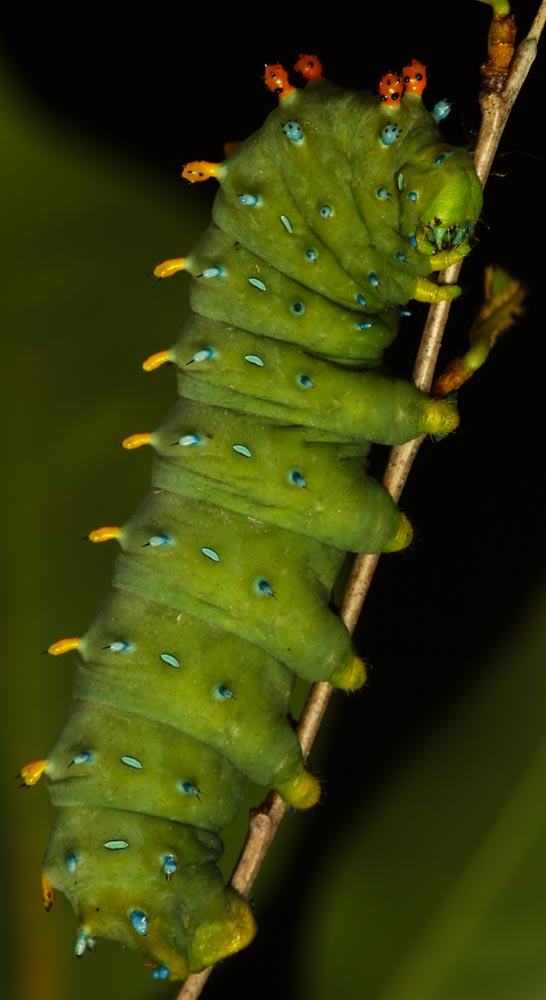
The Cecropia moth caterpillars at Springbrook have become almost groteskly huge and fat. All they do is eat day and night until they can barely waddle to a new leaf.
Of course they need to eat now to have enough fat to overwinter in their cacoons and have the resources to emerge next spring as one of Minnesota's largest and most beautiful moths.
But since late May they have been eating machines.
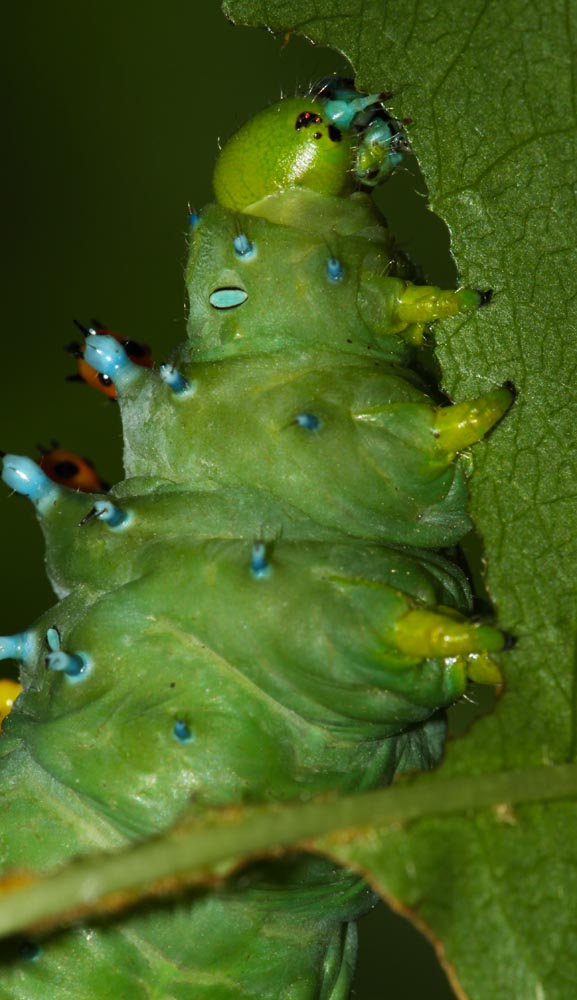
Take a look below at the huge green eyes and the mouth on this caterpillar. It has a transparent upper lip! And pretty weird "teeth" below. I took these pictures in the last few days as I waited to photograph the caterpillars as they transformed into cacoon makers. Scrool down to see the action.
After finally eating all they can hold, the caterpillars sit still for several hours, seemingly transforming their mouth from leaf eating to silk making.
This moth is a member of the Saturnid moth group that includes the caterpillars that silk cloth comes from.
Notice the light blue "spiracles" on each segment of the caterpillar. These are the breathing holes that allow insects to breathe. Also notice the three little "true" legs near the head. Three more on the other side account for its six true legs. The large projections from its abdoman that look like legs are called pseudo or false legs. These "legs" will now dissappear for the rest of this insect's life.
You can see in the picture below how the caterpillar begins to have a glistening silk thread emerge from its mouth, wrapping it all around itself and the branch it is on. Meanwhile its body seems to begin turning white. The silk is sticky when it first comes out but hardens to one of the strongest tensile strength "lines" known on earth.
It takes the caterpillar about 12 hours to get a good start on the cacoon. In another 12 hours it is completely covered but can still be seen, as you can see below. At this time the silk is white, which is the color that the silk stays with real silk worms. Their cacoons are unwound into one long silk thread and then woven into wonderful silk cloth.
But with the wild "silk" moths, the Polyphemus, the Cecropia, and the Luna, here in Minnesota, the "silk" turns brown after another day, as this one was doing yesterday. Some of it is still white but will turn brown within a day.
The caterpillar will continue inside to make a thick wall of silk, and after several days will stop, and in a couple of weeks it will turn into the pupae and wait for the warmth of next May and June to emerge as the adult moth. I'll post more pictures then of the moth.
Senin, 29 Agustus 2011
Minggu, 21 Agustus 2011
Posts by : Admin
Cicadas
The annual cicadas are out and announcing their presence with their high pitched buzzing call. They are usually high up in the trees but they live short lives as adults and soon drop onto driveways or decks and become food for other creatures. This one was alive but lying on my driveway this morning.
Some cicada species live underground for many years. 13 years is one, along with the well known 17 year cicada. But our common cicada is only underground one year.
Cicadas are in the group of insects called Hemiptera, or True Bugs. This group of insects all have straw-like sucking mouth parts and most use their "straw" to pierce plant tissue and suck out nourishment from the plant. After mating, female cicadas lay eggs in the stems of tree branches. The hatchlings drop to the ground and burrow down to one of the tree's roots. They attach their straw like mouth to the root and stay attached for the next year, growing as the tree feeds them.
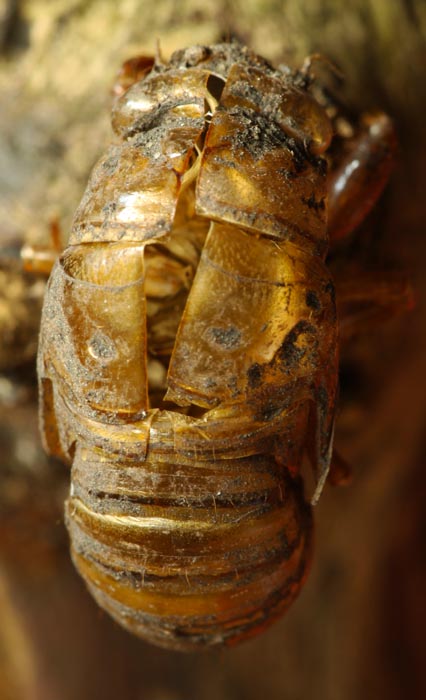
After their year in the ground the larvae crawl out on a late summer night and climb a few feet up the trunk of the tree. In the picture below you can see the shell left after they emerge from the ground with the dirt still attached.
Most everybody has found these left over "skins" of a larvae cicada attached near the bottom of a tree with the obvious split in the back where the adult emerged and crawled up the tree to let its wings dry and expand. I found this empty shell on the tree near my driveway where I found the adult cicada. The adult then flies into the branches and seeks a mate.
This is the male cicada that I found. You can see the slender tube like sucking mouth part sticking down beneath its front legs.
Cicadas are very heavy bodied insects and not very good fliers.
The females listen for the "singing" males, and pick one out that sounds perfect to her. She then flies to the tree and locates the male by his buzzing call. After introductions, if all goes well, they mate and the female then finds an appropriate branch to lay her eggs in.
The male makes his buzzing call by slapping or clapping two pair of plate like body peices together. Here you can see one pair just below the hind leg and to the left of the green wing edge. One lays ontop of the other. As he snaps the top plate down onto the other it makes a snapping sound. When he does this very fast with both pair of double "plates" the loud high pitched buzzing sound is the result.
Hearing the cicadas always means the peak of summer is past, and I'd better enjoy what is left.
Some cicada species live underground for many years. 13 years is one, along with the well known 17 year cicada. But our common cicada is only underground one year.
Cicadas are in the group of insects called Hemiptera, or True Bugs. This group of insects all have straw-like sucking mouth parts and most use their "straw" to pierce plant tissue and suck out nourishment from the plant. After mating, female cicadas lay eggs in the stems of tree branches. The hatchlings drop to the ground and burrow down to one of the tree's roots. They attach their straw like mouth to the root and stay attached for the next year, growing as the tree feeds them.
After their year in the ground the larvae crawl out on a late summer night and climb a few feet up the trunk of the tree. In the picture below you can see the shell left after they emerge from the ground with the dirt still attached.
Most everybody has found these left over "skins" of a larvae cicada attached near the bottom of a tree with the obvious split in the back where the adult emerged and crawled up the tree to let its wings dry and expand. I found this empty shell on the tree near my driveway where I found the adult cicada. The adult then flies into the branches and seeks a mate.
This is the male cicada that I found. You can see the slender tube like sucking mouth part sticking down beneath its front legs.
Cicadas are very heavy bodied insects and not very good fliers.
The females listen for the "singing" males, and pick one out that sounds perfect to her. She then flies to the tree and locates the male by his buzzing call. After introductions, if all goes well, they mate and the female then finds an appropriate branch to lay her eggs in.
The male makes his buzzing call by slapping or clapping two pair of plate like body peices together. Here you can see one pair just below the hind leg and to the left of the green wing edge. One lays ontop of the other. As he snaps the top plate down onto the other it makes a snapping sound. When he does this very fast with both pair of double "plates" the loud high pitched buzzing sound is the result.
Hearing the cicadas always means the peak of summer is past, and I'd better enjoy what is left.
Kamis, 11 Agustus 2011
Posts by : Admin
Deer Fawns
Springbrook's white tail deer fawns are growing up, but they will keep their spots for several more weeks to help hide them in the dappled sunlight of their forest habitat.
They are very curious, but still never get very far from mom, as you can see in the bottom photo. I took these pictures today by Springbrook's feeders
The fawns watch their mom closely, and learn when to be cautious and when it is ok to play.
They are very curious, but still never get very far from mom, as you can see in the bottom photo. I took these pictures today by Springbrook's feeders
The fawns watch their mom closely, and learn when to be cautious and when it is ok to play.
Minggu, 31 Juli 2011
Posts by : Admin
Dragonflies Predators and Prey
Dragonflies, like this Blue Dasher, are one of the insect world's most effective predators. There were many when I took these pictures this morning in Springbrook's south prairie.
But dragonflies also get eaten, mostly by birds, who pluck thier wings off and then eat the nutritious bodies. Cast off wings can be found beneath bird's perches, like this plucked wing I found this morning on this blade of grass.
Posts by : Admin
Monarch and Viceroy Butterflies
Viceroy butterflies taste good, to those that like to eat butterflies. But they don't want to get eaten. And time has favored those that look more like a Monarch butterfly to not get eaten as often, so today we have a Viceroy butterfly that looks more and more like a Monarch butterfly with each passing generation. Evolution at work.
I took these photos today in Springbrook's south prairie about 100 feet apart from each other.
This Monarch tastes terrible because the caterpillar below eats milkweed leaves that are very bitter. After trying to eat one most predators will not try to eat a second Monarch, and most are fooled into thinking the Viceroy is also a Monarch. Mimicry works!
The Viceroy's hind wing stripe is not present on the Monarch as you can see in this picture. This is a male Monarch, identified by the black "scent pouches" along the inside vein on the hind wing. But the two butterflies do look a lot alike.
The Monarch caterpillar chews a notch in the middle vein on the underside of a milkweed leaf so the leaf will fold down. Then the caterpillar hangs from the underside and eats the leaf in relative hiding. But the bright colors on the caterpillar tell all predators that it tastes bad and will make them sick if they eat it.
This caterpillar was on the east end of Springbrook's south prairie this morning, shaking the raindrops off from last night's storms and eating as fast as it could.
I took these photos today in Springbrook's south prairie about 100 feet apart from each other.
This Monarch tastes terrible because the caterpillar below eats milkweed leaves that are very bitter. After trying to eat one most predators will not try to eat a second Monarch, and most are fooled into thinking the Viceroy is also a Monarch. Mimicry works!
The Viceroy's hind wing stripe is not present on the Monarch as you can see in this picture. This is a male Monarch, identified by the black "scent pouches" along the inside vein on the hind wing. But the two butterflies do look a lot alike.
The Monarch caterpillar chews a notch in the middle vein on the underside of a milkweed leaf so the leaf will fold down. Then the caterpillar hangs from the underside and eats the leaf in relative hiding. But the bright colors on the caterpillar tell all predators that it tastes bad and will make them sick if they eat it.
This caterpillar was on the east end of Springbrook's south prairie this morning, shaking the raindrops off from last night's storms and eating as fast as it could.
Sabtu, 23 Juli 2011
Posts by : Admin
Butterflies and Summer

I haven't had time to post anything for a few weeks as there has been no time to go out with the camera. But yesterday this Tiger Swallowtail Butterfly was on the bergamont in front of the interpretive center and I was able to take a few photos. They are large and beautiful butterflies that attract a lot of attention.
This Painted Lady Butterfly was on some thistle near by. They are medium sized, quick flying butterflies with different colors on the underside of the wings than on the top side.
This little skipper butterfly is one of the smallest around and was also on the thistle flowers. These guys fly very fast and stay low in amongst the stems and leaves of the plants, for good reason, as I discovered.
Right after I took this picture a female Eastern Pond Hawk dragonfly swooped in and grabbed the little skipper and flew off to eat him for lunch.
So, life is not just fun in the sun for these pretty decorations in our gardens. They are working hard to find mates and lay eggs before the needs of other critters intersect with theirs!
See dragonfly below enjoying lunch!!
Senin, 04 Juli 2011
Posts by : Admin
Green Frogs Calling
The large male Green Frogs were getting serious about territory and mating this past week at Springbrook as they called all through the day and night. Walking on the floating boardwalk I could see dozens. 30 years ago these frogs were not present at Springbrook but now are the most common frog.
They are attractive frogs with bright yellow throats, green colors, and jewel like big eyes. The large circular "button" behind the eye is the tympanic membrane of its ear.
The frogs suck in air through their nose until they fill up like a balloon. You can see this one looks like he is holding his breath--he is. Then he blows it out quickly, expanding his yellow throat while relaesing the air, making a sound that is compared to a banjo string being plucked.
Other male green frogs hear the sound and see the throat patch size and determine if he is too big for them to take over his territory. Female green frogs hear it and determine if he is the one for them.
Notice the reflection of the boardwalk railing in the eye of the frog below. Lay on your stomach on the baordwalk and you can get close up pictures of the frogs too. But only for the next week or so.
They are attractive frogs with bright yellow throats, green colors, and jewel like big eyes. The large circular "button" behind the eye is the tympanic membrane of its ear.
The frogs suck in air through their nose until they fill up like a balloon. You can see this one looks like he is holding his breath--he is. Then he blows it out quickly, expanding his yellow throat while relaesing the air, making a sound that is compared to a banjo string being plucked.
Other male green frogs hear the sound and see the throat patch size and determine if he is too big for them to take over his territory. Female green frogs hear it and determine if he is the one for them.
Notice the reflection of the boardwalk railing in the eye of the frog below. Lay on your stomach on the baordwalk and you can get close up pictures of the frogs too. But only for the next week or so.
Langganan:
Komentar (Atom)