White tailed deer really show off their ability to survive Minnesota's cold winters at this time of year. If you compare these pictures to the opossum pictures of a few weeks ago you can see why opossums have not been here long.
Deer fur is thick, and each hair is hollow to add insulating value to keep the deer warm. The deer has fur right down to the tip of its nose, and its ears are thickly furred. Not like the Opossum's thin furless ears.
Deer also constantly turn their ears to catch all the sounds around them. Not all of us can turn one ear forward and the other one backward at the same time so no danger can sneak up.
This is my favorite. Look at the long eyelashes on this doe deer. Especially the really long ones along the bottom of the eye. Kind of makes Disney exagerations seem too small. Actually, in the dark when walking through heavy brush these "guard hair" lashes warn of sticks that might injure an eye.
I took these pictures yesterday at Springbrook's wildlife feeders. You can see these and other deer adaptations everyday at Springbrook.
Rabu, 23 Februari 2011
Minggu, 13 Februari 2011
Posts by : Admin
Sure Sign of Spring
It may seem early, but the above freezing temps today feel like a sign of spring. The Goldfinches are way ahead of us, as witnessed by their incoming spring/summer feathers.
These are not the best pictures, but demonstrate how much difference 3 weeks can make in the way a bird looks.
Longer day length is sending a message to the Goldfinch brain, causing it to release hormones that stimulate new feather growth. By the time spring actually gets here these birds will look completely different, and have new colors ready for the summer nesting season.
I took this picture on January 22, and the top picture today. I'll take another in 3 more weeks to see how much change has occurred.
These are not the best pictures, but demonstrate how much difference 3 weeks can make in the way a bird looks.
Longer day length is sending a message to the Goldfinch brain, causing it to release hormones that stimulate new feather growth. By the time spring actually gets here these birds will look completely different, and have new colors ready for the summer nesting season.
I took this picture on January 22, and the top picture today. I'll take another in 3 more weeks to see how much change has occurred.
Sabtu, 12 Februari 2011
Posts by : Admin
Red Eye Champions-Nocturnal Animals
Animals that are active primarily at night have eyes that are highly adapted with many more visual receptors than our human eyes. Each receptor requires lots of fresh oxygenated blood to keep it healthy and functioning.
All that fresh oxygenated blood is what makes eyes look red in a camera flash, and nocturnal animals win the prize for the reddest "Red Eye."
This Barred owl was at Springbrook's feeders looking for prey, using its very healthy eyes to search. I wonder if this is where the term "with blood in his eye" comes from?
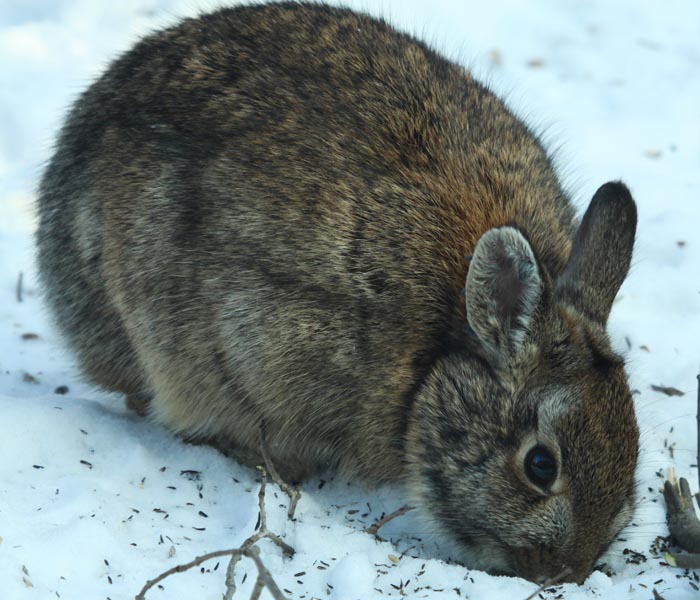
This rabbit was eating at the same feeders a few days ago, but not at the same time. It's eyes are even bigger than the owl's eyes, and one of the blood veins within the eye can even be seen in this photo.
In the end, for nocturnal animals, the one with the best red eye wins all the marbles, and the loser is not in the gene pool any longer.
All that fresh oxygenated blood is what makes eyes look red in a camera flash, and nocturnal animals win the prize for the reddest "Red Eye."
This Barred owl was at Springbrook's feeders looking for prey, using its very healthy eyes to search. I wonder if this is where the term "with blood in his eye" comes from?
This rabbit was eating at the same feeders a few days ago, but not at the same time. It's eyes are even bigger than the owl's eyes, and one of the blood veins within the eye can even be seen in this photo.
In the end, for nocturnal animals, the one with the best red eye wins all the marbles, and the loser is not in the gene pool any longer.
Minggu, 06 Februari 2011
Posts by : Admin
Red Tail Hawk Becomes Efficient Hunter
At Springbrook's birdbanding activity this morning the immature Red Tailed Hawk was back looking for food. He had feasted on another squirrel on Thursday. This morning he was oblivious of all the people setting up bird traps and sat watching the ground around us as we watched him.
Just enough to generate more interest in a larger breakfast.
He stayed in the feeder area all morning as volunteers took birds out of the traps. Late in the morning he shocked us by flying down and catching a Downy Woodpecker at one of the suet feeders! What a surprise! Coopers and Sharp Shins regularly catch songbirds, but large hawks like Red Tails are generally not considered adept enough to catch small woodpeckers in heavily wooded areas of thick brush. This hawk is breaking all the rules...which is exactly what you have to do to survive sometimes. I'm sure it was one of our banded Downy Woodpeckers, but we will never know which one as he ate it all except a few wing feathers.Senin, 31 Januari 2011
Posts by : Admin
Opossums and Global Warming
This Opossum was at the Springbrook bird feeders yesterday morning. First one seen this winter during the day. I saw one at my home feeders this morning. It must be the time of year for Opossums to venture out.
30 years ago there were no opossums at Springbrook or anywhere north of Minneapolis. The winters were too cold for them to survive. Their northward movement is one of the best examples of the impact of Global warming on wildlife that we can immediately see in this area.
Notice the pink nose, pink toes, and thin ears with no fur. The tail also has no fur.
Ears, toes, tails, and noses with no protection freeze in really cold winters, and the attached opossum generally dies without them. So, how cold it gets determines how far north opossums can live.
I took this picture of an opossum near Hartford, Connecticut nearly 37 years ago. Time hasn't changed their looks, but climate change has expanded their range. Hartford is about 41.5 degrees north latitude and Minneapolis is about 44.5. The three degrees difference is about 200 miles.
If this expansion keeps up opossums will be in the Boundary Waters Canoe Area Wilderness raiding my campsite in my lifetime! Displacing wildlife that I enjoy, so long as they don't get into my food sack!
And, climate change is not something that responds quickly (in human measures) to turning around. So get ready you folks up north, along with warmer winters, you also get opossums!!
I think it will be a tough go for eco-tourism to successfully replace polar bears with opossums. Hope they don't have to.
30 years ago there were no opossums at Springbrook or anywhere north of Minneapolis. The winters were too cold for them to survive. Their northward movement is one of the best examples of the impact of Global warming on wildlife that we can immediately see in this area.
Notice the pink nose, pink toes, and thin ears with no fur. The tail also has no fur.
Ears, toes, tails, and noses with no protection freeze in really cold winters, and the attached opossum generally dies without them. So, how cold it gets determines how far north opossums can live.
I took this picture of an opossum near Hartford, Connecticut nearly 37 years ago. Time hasn't changed their looks, but climate change has expanded their range. Hartford is about 41.5 degrees north latitude and Minneapolis is about 44.5. The three degrees difference is about 200 miles.
If this expansion keeps up opossums will be in the Boundary Waters Canoe Area Wilderness raiding my campsite in my lifetime! Displacing wildlife that I enjoy, so long as they don't get into my food sack!
And, climate change is not something that responds quickly (in human measures) to turning around. So get ready you folks up north, along with warmer winters, you also get opossums!!
I think it will be a tough go for eco-tourism to successfully replace polar bears with opossums. Hope they don't have to.
Sabtu, 22 Januari 2011
Posts by : Admin
Nuthatches--Red and White Breasted
During this very cold weather keeping the bird feeders and suet feeders full makes a big difference for the birds.
We have both Red Breasted and White Breasted Nuthatches coming to our feeders several times every day. These are the only birds we see that go down tree trunks head first. Brown Creepers do as well but are seen less often.
The Red Breasted Nuthatch is smaller, seems in more of a hurry, and has a slightly upcurved beak, as you can see in this picture I took today. I turned the picture upside down because it is hard to compare the two birds when one is facing down
This is a female White Breasted Nuthatch, determined by the crown color. The male would have a jet black crown instead of the grayish crown this bird has.
The White Breasted Nuthatch often also eats seeds from the feeder, but I have never seen the Red Breasted eating seeds.
We have both Red Breasted and White Breasted Nuthatches coming to our feeders several times every day. These are the only birds we see that go down tree trunks head first. Brown Creepers do as well but are seen less often.
The Red Breasted Nuthatch is smaller, seems in more of a hurry, and has a slightly upcurved beak, as you can see in this picture I took today. I turned the picture upside down because it is hard to compare the two birds when one is facing down
This is a female White Breasted Nuthatch, determined by the crown color. The male would have a jet black crown instead of the grayish crown this bird has.
The White Breasted Nuthatch often also eats seeds from the feeder, but I have never seen the Red Breasted eating seeds.
Minggu, 09 Januari 2011
Posts by : Admin
Jackalopes???
With temps well below zerro this morning, the cottontail rabbits decided to risk eating in the daytime as well as at night at the feeders.
This bunny looked pretty normal until it turned its head sideways. Those sure look like antler tips sticking out behind its ear until you look closer.
Rabbits sometimes have growths on their ears/heads caused by the Shope papilloma virus. They can grow quite large, I've seen them twice as long as their ears. They eventually fall off and don't seem to effect the rabbits.
Still, they look pretty weird.
The growths on this rabbit are still quite small, but in a few months they may get 8 or 10 inches long. Maybe this rabbit will pose again. The long growths seem to be where the world wide myths of "Jackalopes" comes from. Google jackalopes and you will find rabbits with antlers and other attachments are quite popular in art, taxidermy, and story.
This bunny looked pretty normal until it turned its head sideways. Those sure look like antler tips sticking out behind its ear until you look closer.
Still, they look pretty weird.
The growths on this rabbit are still quite small, but in a few months they may get 8 or 10 inches long. Maybe this rabbit will pose again. The long growths seem to be where the world wide myths of "Jackalopes" comes from. Google jackalopes and you will find rabbits with antlers and other attachments are quite popular in art, taxidermy, and story.
Langganan:
Komentar (Atom)